Tradition: Japanese Mythology
Alternative Names: 猪の化物, Boar Monster
Category: Pig
The Myth
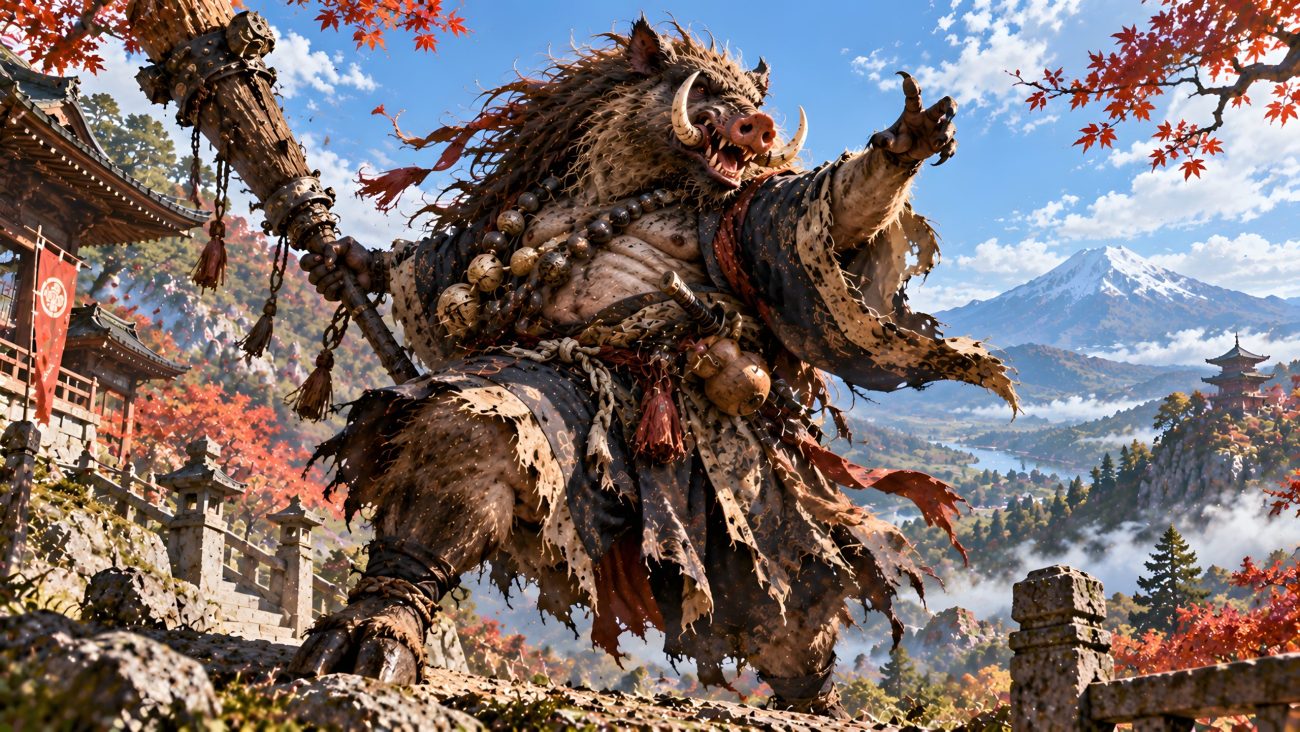
Inoshishi Bakemono, meaning “Boar Monster,” is a satirical yokai-like figure described in Ōmachi Keigetsu’s Eiri Kunwa, published in 1916. It appears among forty-one supernatural figures used to caricature different human temperaments in a section titled Hyakki Chigyō. In an illustration by Hirafuku Hyakusui, the creature is depicted as a boar standing upright on two legs.
Rather than describing a conventional monster, the author uses the Boar Monster as a metaphor for people who pursue a single skill or area of knowledge while remaining ignorant of everything else. A scholar who understands nothing beyond academic learning and a soldier who knows only swordsmanship are both described as examples of this type. The figure embodies reckless, narrow-minded behaviour: like a boar that lowers its tusks and charges blindly forward, such people can cause destruction without considering the consequences.
The author warns that encountering a Boar Monster can leave an entire country, society, household, or individual in ruins. Within a family, such a person might become a son disowned by his parents; outside the home, he might end up in prison. The text also acknowledges that reckless warriors, such as those who charged fearlessly into battle, could sometimes achieve important victories. The Boar Monster, however, represents the destructive extreme of this temperament: a person so consumed by one pursuit and so unwilling to consider anything else that his actions bring disorder wherever he goes.
Sources
“Inoshishi-bakemono.” 新版TYZ 妖怪図鑑 (New TYZ Yokai Encyclopedia). https://tyz-yokai.blog.jp/archives/1073453373.html?utm_source=chatgpt.com