In the peatlands of the Soesterveen near Soest, people once spoke quietly of small beings called Meuzelmannekens. They were a kind of earth folk, living unseen among the turfhopen—the stacked piles of peat that lay drying on the land. While the peat remained, the Meuzelmannekens dwelled within it. When the turfhopen were taken away, they slipped back into the earth itself, vanishing without trace.
They were also said to live in the grain fields near the Lazarusberg. While the corn stood tall, the Meuzelmannekens remained hidden among the stalks. But when harvest time came and the fields were cut bare, they withdrew once more into the mountain. There, deep within the hill, they spent the entire winter, sheltered beneath the ground.
No one ever truly saw them. They caused no harm, stole nothing, and brought no illness or fear. Their presence was known only through tradition and quiet belief, as beings who shared the land but never troubled those who worked it.
The Meuzelmannekens were remembered as peaceful dwellers of soil and field, moving with the rhythms of harvest and winter, retreating into earth and hill as naturally as seeds sinking back into the ground.
In old Flemish tales there is a sinister little being known as the Galgenjong, a creature bound to bargains and blood. In its smallest form it appears as a tiny black beast, no larger than a pea, with a blood-red mouth. At other times it takes on a clearer shape: a gnome-sized figure, as large as a child’s doll, black-skinned, with shining eyes and a red tongue. In this form it hides itself in a small box or a pouch, waiting for its owner’s command.
Whoever possesses a Galgenjong gains unnatural advantages. Their hands move faster than any other worker’s, their strength exceeds human limits, and luck follows them—especially in games of cards. The creature can see what is yet to come and knows where hidden treasures lie, whispering secrets no ordinary person could uncover.
But its gifts are never free. Each day the Galgenjong must be fed a drop of its owner’s blood. Without this offering it grows restless and dangerous. Though it brings fortune to its master, it spreads misfortune to everyone around them. Neighbors fall into bad luck, accidents multiply, and prosperity withers wherever the creature lingers.
To obtain a Galgenjong, one must commit oneself to darkness. Some say it can be gained by fasting for three days in honor of the Devil. Others claim it comes only through joining a secret and wicked brotherhood. Once acquired, the creature is almost impossible to be rid of. It cannot be dismissed or destroyed by its owner’s will alone. Only if someone else steals it away can its bond be broken.
If the Galgenjong remains with its master until death, it claims its final payment. When the owner dies, the creature carries their soul with it, dragging it down to hell as the last fulfillment of the pact.
Thus the Galgenjong is remembered as a source of power and ruin alike: a tiny servant of immense danger, promising success in life while quietly ensuring damnation in the end.
In the farmhouses and old family homes of northern Japan, there lives a mysterious child spirit known as the zashiki-warashi. It appears as a young child—sometimes five or six years old, sometimes closer to twelve—often with a red face and long or cropped hair. Though it looks human, it is not. It belongs to the house itself.
A zashiki-warashi dwells in the inner rooms of prosperous households, especially among wealthy farmers or old, respected families. As long as the child spirit remains, the house flourishes. Crops grow well, money comes easily, and the family prospers. But if the zashiki-warashi leaves, misfortune soon follows. Wealth drains away, sickness appears, and families fall into ruin.
The spirit is playful and unpredictable. It may wander around beds at night, flip pillows, make footsteps in empty rooms, or rustle paper screens. Sometimes it laughs, sometimes it snorts, and sometimes it speaks openly with people. Guests may glimpse it crouching beneath a household altar or peeking from behind doors. In other homes, it remains unseen, known only through sounds and disturbances.
Some houses are said to host more than one zashiki-warashi. In certain villages, they are even ranked—some higher, some lower—each with a different temperament and influence. A few appear as boys, others as girls, and some are remembered as former princesses or noble children bound to the house by fate.
Many stories tell of disaster following their departure. In one tale, two zashiki-warashi were seen moving from a house to another; soon after, nearly the entire family left behind died from poisoned food. In another, a household fell into poverty the moment its spirit vanished. These stories serve as warnings: the spirit’s presence must be respected, never mocked or driven away.
Most strangely, zashiki-warashi do not reveal themselves to everyone. Often, only the head of the household can see them—and even then, only a few times in a lifetime. To others, the spirit remains invisible, known only by laughter in empty rooms or footsteps where no child should be.
Thus the zashiki-warashi endures as both blessing and omen: a child who brings fortune, a spirit bound to home and lineage, and a reminder that prosperity, once lost, may never return.
Tradition / Region: Chinese Mythology Alternate Names: Red Willow Boys, Tamarisk Children Category:Gnome
The Myth
In the deep mountains near Urumqi, herders tell of tiny people who appear when the red willows bloom. They are no taller than a foot or two and resemble miniature men, women, and children. When spring comes and the willow branches redden, these beings break off the twigs, bend them into small hoops, and wear them as crowns upon their heads.
They gather in groups and dance among the valleys, moving in circles and making soft, musical sounds, like a distant song carried by the wind. Their dancing is joyful but fleeting, and they vanish as suddenly as they appear.
At times, the Red Willow Children creep into camps or tents to steal food. When caught, they do not resist. Instead, they fall to their knees and weep like frightened children. If tied or imprisoned, they refuse all food and soon die. If released, they move away timidly at first, walking only a short distance before turning back to look. If shouted at or chased, they kneel again and cry. Only when they are far enough away to know they are safe do they finally flee, crossing streams and mountains and disappearing into the wilderness.
No one has ever found their nests or homes. They seem to belong neither fully to the forest nor to the mountains, and their true nature is uncertain. Some say they are neither spirits nor beasts, but something in between.
One tale tells of a local magistrate who once captured a Red Willow Child and brought it away for closer inspection. Its hair, eyebrows, and beard were said to be indistinguishable from those of a human. This discovery led some to believe that the ancient stories of little people hidden in the wild places of the world might be true after all.
Thus the Red Willow Children remain beings of song and sorrow—small, elusive figures who dance beneath blooming willows and vanish before they can ever be fully understood.
Tradition / Region: British Mythology Alternate Names: — Category:Gnome, House dweller
The Myth
In the borderlands between England and Scotland, old mills were said not to work by human hands alone. Hidden among the gears, beams, and sacks of grain lived a strange spirit known as the Kilmoulis.
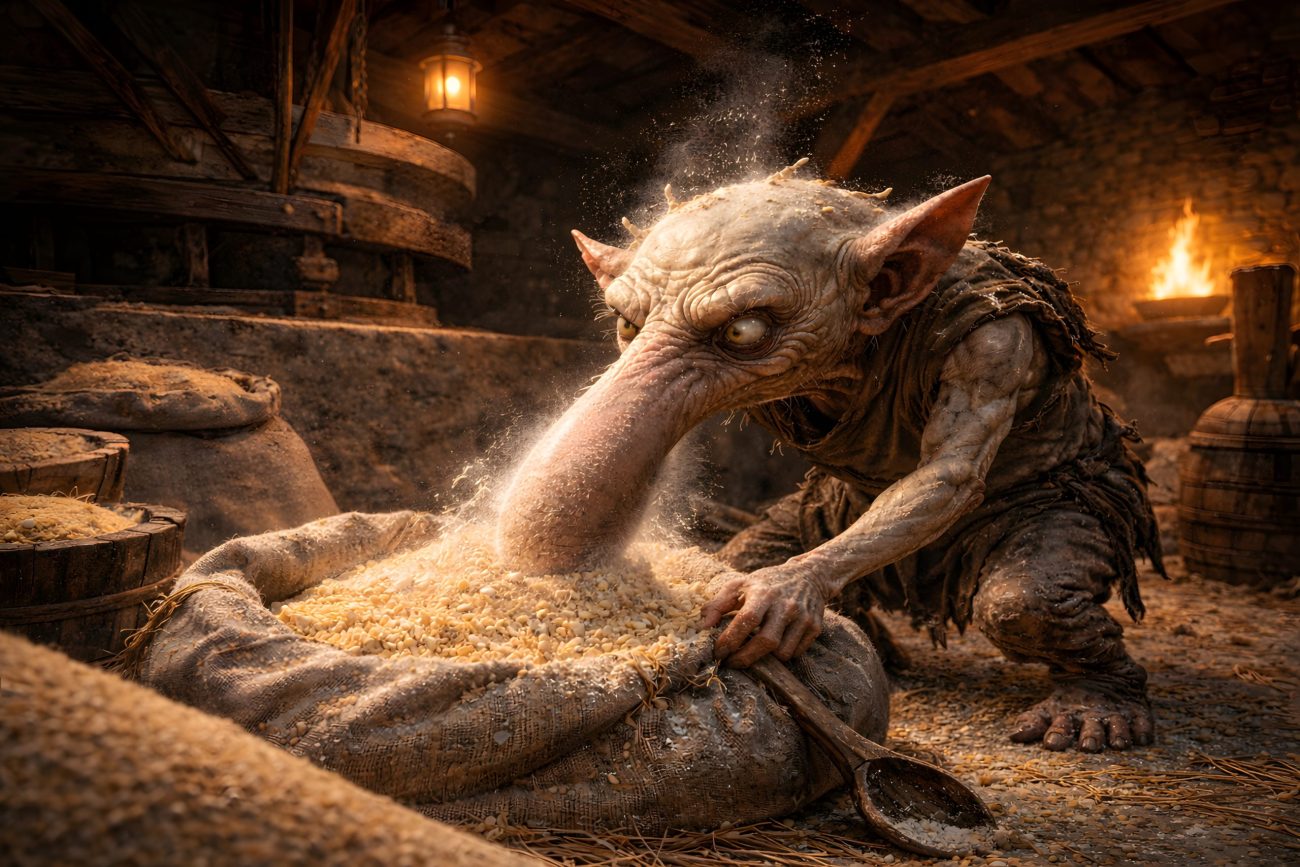
The Kilmoulis was a cousin to the brownie, but far uglier. He was described as having an enormous nose and no mouth at all. Because of this, he could not eat in any ordinary way. Instead, he inhaled his food through his nose, drawing in meal, porridge, or scraps left behind in the mill. This grotesque habit made his presence unmistakable to those who knew the signs.
Despite his appearance, the Kilmoulis was a diligent worker. By night, when the mill was quiet, he labored tirelessly—turning wheels, cleaning stones, and keeping the machinery in order. Millers who treated their mills with respect often found their work mysteriously eased, grain ground faster, and breakdowns fewer.
Yet the Kilmoulis was also a trickster. He delighted in pranks: hiding tools, scattering grain, making strange noises, or confusing workers by rearranging things overnight. These tricks could be maddening, but they were rarely malicious. The spirit’s mischief was part of his nature, as inseparable from him as his labor.
So long as the miller tolerated the disturbances and left small offerings of food, the Kilmoulis remained a net blessing. His work outweighed his trouble. But if insulted, mocked, or driven away, the mill might fall into disrepair, its luck souring as suddenly as it once flourished.
Thus the Kilmoulis was remembered as both nuisance and necessity: an ugly, nose-sniffing mill spirit whose hard work and mischief turned endlessly together, like the millstone itself.
Gallery
Sources
Wikipedia contributors. (n.d.). Kilmoulis. In Wikipedia, The Free Encyclopedia, from https://en.wikipedia.org/wiki/Kilmoulis
High in the Alps, beyond the tree line and close to the snow-buried peaks, live the Barbegazi. They are beings of winter alone, creatures who belong to blizzards, avalanches, and frozen heights. When summer comes and the mountains soften, they vanish into deep hibernation within their hidden tunnels. Only when the cold returns do they stir again.
The Barbegazi dwell in networks of caves beneath the highest ridges, their entrances concealed by ice and drifting snow. They thrive only in extreme cold. In winter storms they emerge, moving easily across slopes where humans struggle to stand. Their enormous feet act like skis or snowshoes, letting them glide effortlessly over deep snow. Some say they delight in riding avalanches, laughing as they race the falling mountainside.
They are masters of snow. If buried, they can vanish beneath it in seconds or dig themselves free no matter how deep the drift. Their beards and hair hang stiff with ice, forming thick icicles that glitter in the cold. When the ice melts, ordinary hair lies beneath, but such warmth rarely touches them.
Though secretive, the Barbegazi are not cruel. Travelers tell that before an avalanche strikes, strange whistles or hollow hooting sounds echo across the peaks. These noises are said to be the Barbegazi, warning hikers away from danger. Others claim they have seen small figures digging frantically in the snow after storms, freeing trapped people or guiding lost sheep back toward safety.
Yet they are uneasy around humans. No Barbegazi is ever seen in mild weather, and none appear below the forests. Those rare stories of captured Barbegazi all end the same way: once removed from the cold, the creature weakens and dies within hours, as if winter itself were its lifeblood.
Thus the Barbegazi remain spirits of ice and altitude—helpers and watchers of the high mountains, fleeting as snowstorms, and gone as soon as the cold loosens its grip.
In the villages of Ophoven and Molenbeersel, people once spoke of strange little beings known as the Antonen. They were a kind of earth spirit, much like the aardmannetjes, but darker and more secretive. Their skin was said to be black, and they lived hidden away from human sight, close to the ground and the old places of the land.
The Antonen were said to worship a golden calf, which they had buried in a secret place known only to them. There, underground and unseen, they honored it in silence, guarding both the idol and its location with great care.
For a long time they remained near the villages, unseen but present. Then the church bells began to ring the Angelus. The sound of the bells carried across fields and forests, cutting through earth and air alike. At the first ringing, the Antonen fled in terror. The holy sound was unbearable to them, and they abandoned their hidden places, their buried calf, and the land they had once inhabited.
After that, they were never seen again. Yet people say that wherever the Antonen once lived, the ground still remembers them—and that somewhere beneath the earth, the golden calf may still lie buried, waiting in silence.
Gallery
Sources
Abe de Verteller contributors. (n.d.). Van aardmannetje tot zwarte juffer: Een lijst van Nederlandse en Vlaamse elfen en geesten. In Abe de Verteller, from https://abedeverteller.nl/van-aardmannetje-tot-zwarte-juffer-een-lijst-van-nederlandse-en-vlaamse-elfen-en-geesten/
There was once a man named Tan Jinxuan who devoted himself to inner cultivation. He practiced breathing and stillness, enduring heat and cold alike, believing that persistence would bring insight. For many months nothing happened—until one day, as he sat quietly, he heard a faint whisper inside his ear, as soft as the buzzing of a fly.
The voice said, “You can see me.”
When Tan opened his eyes, the sound vanished. When he closed them and calmed his mind, the whisper returned. Each time he sat in meditation, the tiny voice spoke again, and Tan grew convinced that something truly lived within his ear.
One day, when the voice spoke once more, Tan answered it. At that moment, a tiny being leapt out from his ear and fell spinning onto the ground. It was no more than three inches tall, shaped like a small man with a fierce face like a yaksha, savage and sharp-eyed despite its size.
Tan stared in astonishment as the little creature whirled about, real and solid, no longer hidden. Before he could grasp it or speak further, it vanished as suddenly as it had appeared, leaving Tan alone with the certainty that unseen beings dwell closer to humans than anyone suspects.
Thus it was said that some spirits live not in forests or mountains, but within the body itself—heard only in silence, seen only by those who dare to listen.
Gallery
Sources
Wikipedia contributors. (n.d.). 耳中人. In Wikipedia, The Free Encyclopedia, from https://zh.wikipedia.org/wiki/%E8%80%B3%E4%B8%AD%E4%BA%BA
Beneath fields, hills, and old farmyards live the aardmannetjes, small earth beings usually dressed in green. They dwell unseen beneath the ground, moving quietly through the soil, and though most people never glimpse them, their presence is felt in subtle ways.
The aardmannetjes help humans with their work, but only if they are not watched. Crops grow straighter, tools are found where they were lost, and tasks seem to finish themselves overnight. Yet they do not tolerate curiosity. Anyone who spies on them risks punishment, for the aardmannetjes are said to blow out the eye of those who try to observe them.
They are also known to steal human children, leaving one of their own in the cradle instead. The small pipes sometimes found sticking out of the ground are said to be aardmanspijpjes, openings to their hidden homes. Whoever builds a house on land where aardmannetjes live invites disaster: such houses are doomed to be destroyed by fire or storm, again and again.
In Friesland, the ierdmantsjes are said to dance in the middle of cornfields, singing a strange song: “Monday, Tuesday, Wednesday.” Once, a hunchback overheard them and dared to finish the song with “Thursday, Friday.” Instead of punishing him, the earth beings laughed and rewarded him by removing his hump.
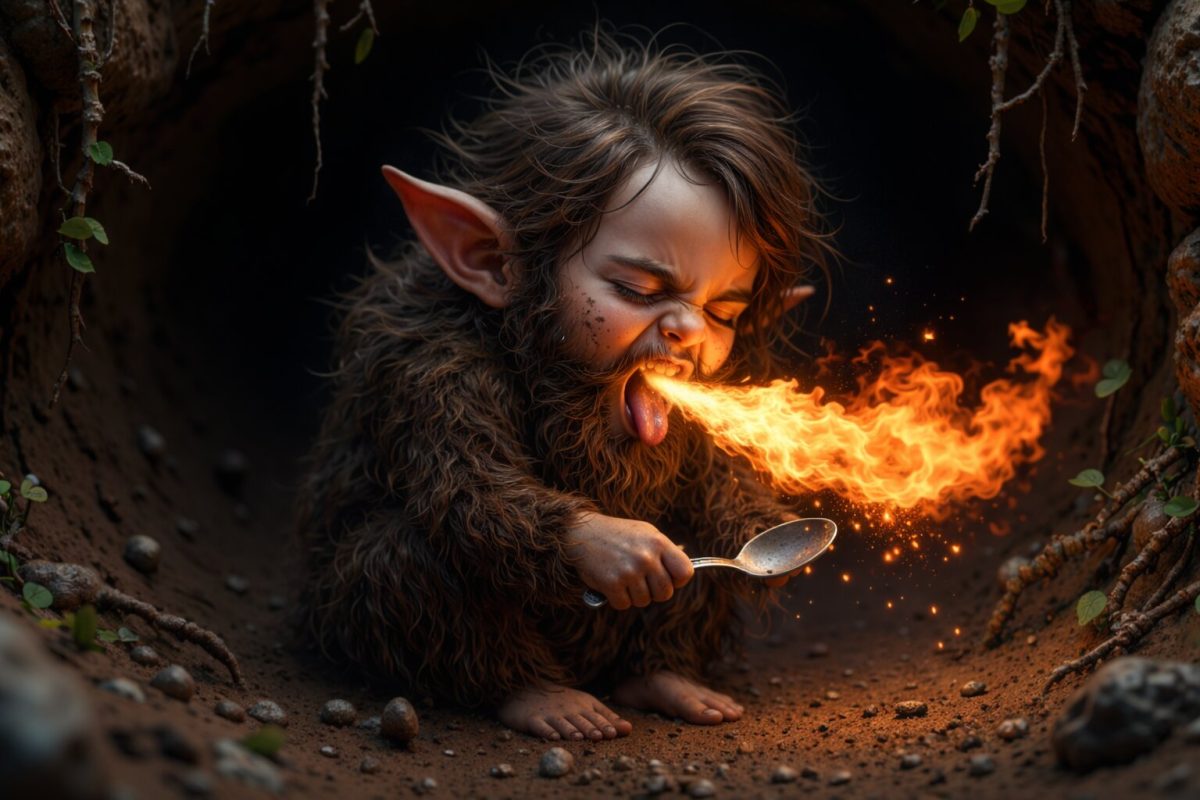
In another tale, a mighty, hairy aardman lived in the Aardjesberg near Bussum. Each year he demanded a maiden as his bride. When no maidens were left, his rage grew uncontrollable. He spewed fire from his mouth, and the nearby village was burned to the ground, house by house, until nothing remained.
Thus the aardmannetjes are remembered as helpers and destroyers alike—generous when respected, merciless when crossed—guardians of the earth who demand silence, distance, and humility from those who live above them.
Limburg
In the folklore of Limburg, especially along the River Maas, people once believed in small underground beings called aardmannetjes (little earth men). According to local legends, they lived in tunnels beneath places such as the ruins of Stein Castle. These creatures slept during the day and came out at night. They were said to wander through houses borrowing kitchen utensils, milking cows, and sometimes causing quarrels among servants, whom they would watch and laugh at from a distance.
Stories about them were told across many Limburg villages. In Doenrade, a servant once tried to trick the aardmannetjes by putting pieces of old shoe leather into a pot of rice pudding meant for them. When the dwarfs discovered the prank, they realized they were being spied on and extinguished the servant’s light—after which he was said to have lost an eye.
In Roggel, the aardmannetjes were believed to borrow pots and pans at night and return them before morning, carefully cleaned. They were harmless as long as people left them alone and did not try to look at them. According to tradition, they eventually disappeared because they could not tolerate the sound of church bells.
Similar traditions placed them at other locations such as Pijpersberg, Spekberg near Tegelen, and near Nunhem and Heithuizen. At Spekberg, legends claimed the small people once lived inside the sandy hill and smoked tiny pipes. Small clay pipes occasionally found in the ground were popularly believed to have belonged to these beings, though scholars later suggested they were early tobacco pipes.
One famous incident occurred around 1832, when a local man secretly buried small pipes in the hill and later “discovered” them, claiming they were relics of the aardmannetjes. After an investigation by the Belgian authorities, he confessed the find was a hoax.
Frisia
Another story from Maasbree tells that when a fire destroyed twenty-two houses, one home remained untouched because its owner had always lent household items to the little people. Like many supernatural beings in European folklore, the aardmannetjes were eventually said to have vanished when church bells and Christian practices spread through the region.
An old folk tale tells of a farm laborer named Sjoerd, who was known in his village as Sjoerd Bult because of his large hunchback. One evening, as he and his wife returned from the fields by moonlight, they crossed a wheat field and heard a strange buzzing sound. Soon countless aardmannetjes—tiny earth-dwelling beings—climbed out of the furrows and began dancing.
Seeing the pitchfork Sjoerd carried (whose shape resembled a cross), the little creatures showed respect and did not harm him. Instead they asked him to join their dance. As they danced, they sang the same short verse over and over:
“Monday, Tuesday, Wednesday.”
Sjoerd laughed and told them their song was incomplete. He added the missing days—“Thursday, Friday, Saturday.” The earth men were delighted and offered him a reward: he could choose either wealth or beauty. Sjoerd chose to be rid of his hunchback. The dwarfs tossed him high into the air, and when he landed, his back was straight.
When the villagers saw Sjoerd the next day, they were amazed. But a greedy and ill-tempered tailor named Semme, who lived in the same village, demanded to know how the miracle had happened. That night he went to the field himself. Trying to imitate Sjoerd, he clumsily added “Sunday” to the song, but he demanded the reward that Sjoerd had refused—wealth. The earth men laughed, tossed him into the air, and when he landed he had gained Sjoerd’s old hump.
Later Sjoerd returned to the field once more. The aardmannetjes explained that they had been forced to dance every moonlit night until someone completed their song. Because Sjoerd had done so, they were now free to return to their underground realm. As thanks, they filled his sack with small bags of gold. When Sjoerd arrived home, the treasure had turned into stones and leaves—but when he sprinkled holy water on them, they transformed back into gold and precious jewels.
From that day on, Sjoerd became a wealthy man and no longer had to depend on the greedy tailor.
Gallery
Sources
Abe de Verteller contributors. (n.d.). Van aardmannetje tot zwarte juffer: Een lijst van Nederlandse en Vlaamse elfen en geesten. In Abe de Verteller, from https://abedeverteller.nl/van-aardmannetje-tot-zwarte-juffer-een-lijst-van-nederlandse-en-vlaamse-elfen-en-geesten/
The Bull of Heaven was a creature of immense and terrifying power, kept under restraint by the gods because its release meant ruin for the world. When it was allowed to roam the earth, famine and destruction were sure to follow.
After the hero Gilgamesh returned to Uruk in triumph, the goddess Ishtar desired him and offered herself as his consort. Gilgamesh rejected her, reminding her of the many lovers she had ruined and cast aside. Humiliated and enraged, Ishtar ascended to the heavens and demanded that her father, the sky-god Anu, release the Bull of Heaven so she might punish Gilgamesh.
Anu warned her that unleashing the Bull would bring years of famine and suffering. Ishtar answered that she had prepared stores of grain enough for gods, humans, and beasts alike. At last, Anu relented and handed the Bull of Heaven over to her.
Ishtar released the Bull upon the land. With its first breath, the earth split open and swallowed a hundred men. With its second breath, another chasm opened, claiming two hundred more. Fields were ruined, the ground cracked beneath its hooves, and terror spread through Uruk as the monstrous bull ravaged the land.
Gilgamesh went out to face the Bull, joined by his companion Enkidu. As the creature charged, Enkidu seized it from behind, gripping its tail and holding it fast. In that moment, Gilgamesh struck, plunging his sword into the Bull’s neck and killing it. They cut out its heart and offered it to the sun-god Shamash in thanks.
When Ishtar saw the Bull of Heaven slain, she climbed the walls of Uruk and cursed Gilgamesh. In defiance, Enkidu tore the Bull’s thigh from its body and hurled it at her. Ishtar gathered her followers and mourned the fallen beast.
But the killing of a divine creature could not go unpunished. The gods met in council and decreed that one of the two heroes must die. Their judgment fell upon Enkidu. Soon after, he was struck by illness and died, having visions of the Underworld before his end.
The death of Enkidu shattered Gilgamesh’s heart and marked the turning point of his life. From the slaying of the Bull of Heaven came not triumph, but grief—and the beginning of Gilgamesh’s search for meaning beyond strength and glory.
Gallery
Sources
Jacobsen, T. (1976). The Treasures of Darkness: A History of Mesopotamian Religion. Yale University Press, pp. 195–215.
Wikipedia contributors. (n.d.). Bull of Heaven. In Wikipedia, The Free Encyclopedia, from https://en.wikipedia.org/wiki/Bull_of_Heaven