Orabi Souke

Tradition / Region: Japan (northern Nagasaki Prefecture, northwestern Saga Prefecture)
Alternate Names: Orabi Soute, Yama Orabi
Category: Mountain dweller / yokai


The Myth

Orabi Souke is a mountain-dwelling monster said to exist in the mountainous regions of northern Nagasaki Prefecture and northwestern Saga Prefecture. It is not commonly seen, but its presence is known through encounters and sounds heard deep in the mountains.

According to local belief, if a person encounters Orabi Souke and attacks it, the creature will immediately retaliate. For this reason, it is feared as a being that responds directly to aggression. People are warned not to strike at it or provoke it, as doing so invites danger.

In Yame County in the Chikugo region, a similar creature is known as Yama Orabi. Though related in name and behavior, Orabi Souke is considered distinct from Yamabiko, also called Yama Hibiki, which is associated with echoes rather than physical retaliation.

The name Orabi Souke is partially explained through language. The word orabu means “to shout,” suggesting a connection to loud cries or calls heard in the mountains. The meaning of souke is unclear, and some sources record the name instead as Orabi Soute, leaving uncertainty as to which form is correct.

Beyond these details, Orabi Souke remains a little-seen mountain being, known primarily through regional accounts and warnings passed down among those who travel or work in the mountains.


Interpretive Lenses

Religious Readings
Philosophical Readings
Psychological Readings
Esoteric Deep Dive
Political / Social Readings
Other

Orabi Souke — A Hermeticism Deep Dive

Hermeticism approaches mountain beings as reactive intelligences, presences that do not initiate contact but mirror force directed toward them. Mountains are not silent matter; they are compressed stability, domains where action rebounds rather than disperses. Orabi Souke is not an aggressor—it is retaliatory law embodied, revealing how violence aimed at the environment returns amplified.

What kind of being answers only after you act—and never first?


Lens Effect

Under this lens, Orabi Souke appears as:
a reflexive guardian of place, manifesting consequence rather than intention.

Primary effect on humans:
It disciplines aggression, training restraint by ensuring that force immediately rebounds upon its source.


1. Encounter and Retaliation — Reflexive Law

Orabi Souke does nothing until struck. Hermetically, this marks reflexive causality, where action and consequence are tightly bound with no delay. The mountain does not judge motive; it responds to impact.

This makes Orabi Souke a threshold regulator. Those who pass without hostility remain untouched; those who impose force are met with immediate correction.


2. The Shout — Acoustic Manifestation

The name’s link to orabu (“to shout”) points to sound as presence, not speech. Hermetically, sound functions as pressure made audible, the first sign of reaction before form appears.

Unlike echo spirits such as Yamabiko, Orabi Souke’s sound is not repetition but warning resonance—a signal that force has entered a domain where return is guaranteed.


3. Obscure Form and Name — Non-Fixed Identity

The uncertainty around souke / soute and the creature’s indistinct appearance indicate non-fixed manifestation. Hermetically, beings that enforce law do not require stable form; their authority lies in effect, not visibility.

Orabi Souke remains vague because clarity is unnecessary. What matters is response, not recognition.


Final Reading

Under a Hermetic lens, Orabi Souke is consequence given locality, a mountain-bound intelligence that ensures aggression never travels outward unchecked. It teaches that some domains do not absorb force—they return it intact.


Lesson for the Reader

Do not test what does not provoke you. Where power is compressed, restraint is the only safe movement. If you strike first, you forfeit distance between action and consequence. Learn where silence is not emptiness, but held response.


“Some places do not answer questions—only blows.”

Anhangá

Tradition / Region: Indigenous Brazilian folklore (Tupi and related peoples)
Alternate Names: Anhanga, Anhan, Agnan, Kaagere
Category: Deer


The Myth

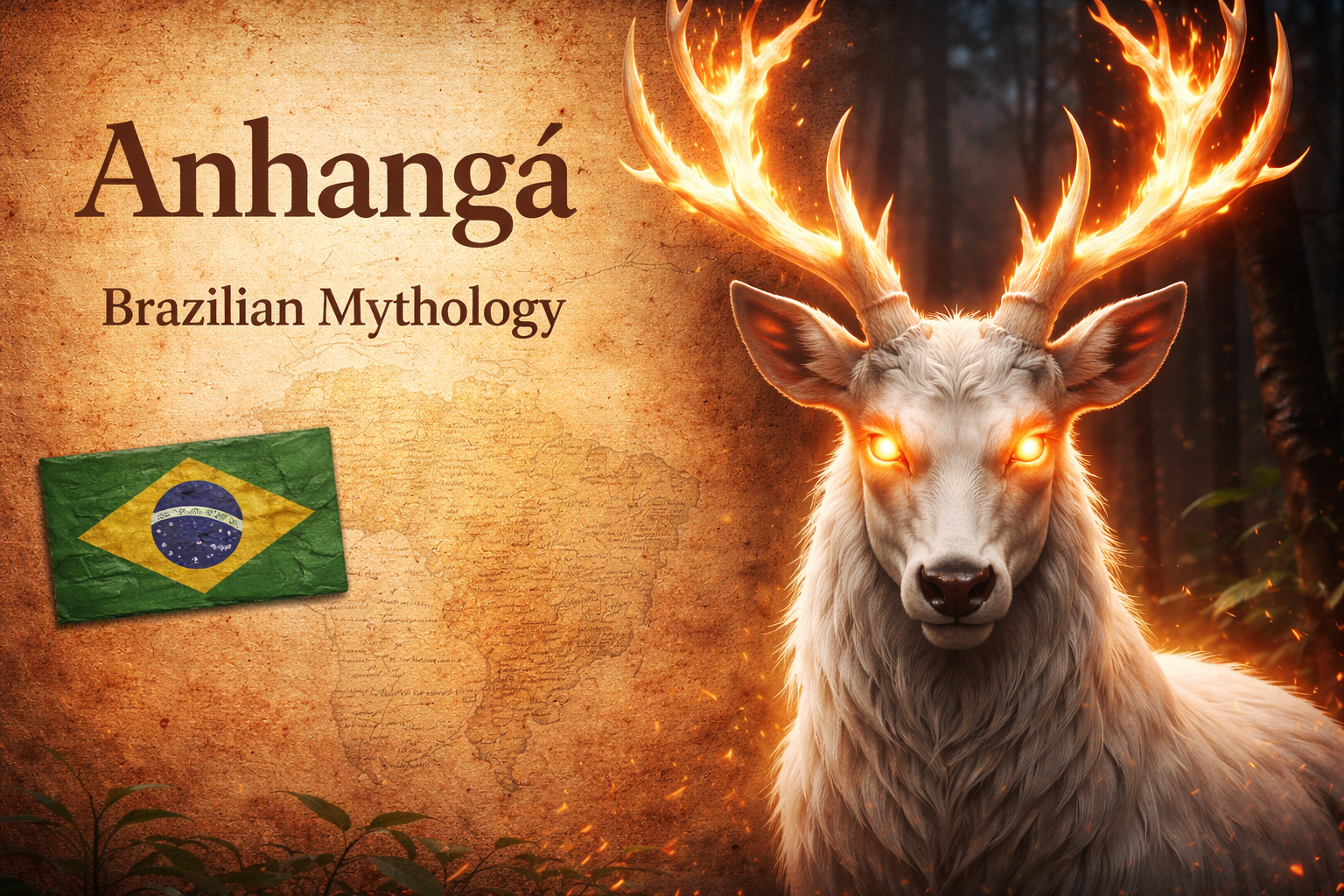
Anhangá is a feared spirit known among many Indigenous peoples of Brazil. It is said to torment both the living and the dead, appearing in nature through sudden, violent sounds such as storms, tempests, and unexplained noises. The presence of Anhangá brings fear, confusion, illness, and suffering.

Most often, Anhangá appears in the form of a deer. Hunters describe seeing a white or red deer with burning, fiery eyes, sometimes with antlers covered in hair. This deer is not an ordinary animal but a spirit that guards wildlife. It watches over animals in open fields and forests and punishes hunters who hunt abusively, especially those who pursue females with young.

When Anhangá intervenes in a hunt, it brings fever, madness, and confusion. A hunter may lose his sense of direction, mistake one being for another, or act against his own family without realizing it. In one well-known story, a hunter chased a doe and her nursing fawn. He seized the fawn to draw the mother closer and fired his weapon. Only afterward did he discover that Anhangá had deceived him, and that he had killed his own mother, mistaking her for the animal.

Anhangá does not appear only as a deer. It is said to take many forms in order to deceive and afflict people. It may appear as birds, mammals, fish, reptiles, or strange hybrid beings. These forms include an armadillo, a pirarucu fish, a turtle, oxen, birds such as the tinamou, and human-like figures. Because of this, hunters and travelers are taught never to trust appearances in the wilderness.

The spirit is also believed to torment the souls of the dead. During funerary rituals, people feared that Anhangá would seize the soul on its journey to the Land Without Evils, a blessed place where virtuous souls were meant to go. To protect the dead, food offerings were placed near the burial site so that Anhangá would consume the offerings instead of the soul. Fires were kept burning to warm and protect the deceased and to keep Anhangá at a distance. The living encouraged the dead to keep their fires from going out.

It was believed that only the most virtuous souls — those who had defended their people and killed many enemies — reached the high mountain of the Land Without Evils. Those who failed in this were said to fall under the power of Anhangá, becoming tormented spirits themselves.

Anhangá was also feared during travel, especially over water. Storms and violent sounds were sometimes believed to be caused by the spirits of the dead associated with Anhangá. Among some groups, Anhangá was said to follow or serve Jurupari, and together they were feared as dangerous spirits capable of possession, kidnapping, and death.

Because Anhangá could change form at will, it was impossible to know when it was near. Its presence was marked by fear, illness, illusion, and the sudden reversal of fortune. Hunters, mourners, and travelers all treated the wilderness with caution, knowing that Anhangá might be watching, waiting to punish disrespect, cruelty, or weakness.


Interpretive Lenses

Religious Readings
Philosophical Readings
Psychological Readings
Esoteric Deep Dive
Political / Social Readings
Other

How to Invite This Spirit

Anhangá — A Hermeticism Deep Dive

Hermeticism approaches spirits of the wild not as demons of chaos, but as regulatory intelligences that enforce balance where human desire threatens excess. Nature, in this view, is not passive matter but a living system of correspondences, defended by forces that distort perception when ethical limits are breached. Anhangá is not evil incarnate; it is retributive imbalance made perceptible, emerging when human action violates the internal law of the land.

What kind of guardian punishes not the body, but the certainty of perception itself?


Lens Effect

Under this lens, Anhangá appears as:
a corrective intelligence of the wild, enforcing ecological and moral limits through illusion and terror.

Primary effect on humans:
It fractures perception and judgment, dissolving confidence, direction, and identity when restraint collapses.


1. Storms and Sudden Sounds — Atmospheric Manifestation

Anhangá announces itself through storms, crashes, and unexplained noises. Hermetically, this marks energetic overflow, when pressure within a system exceeds containment and discharges through the environment.

These sounds are not messages but signals of imbalance, warnings that circulation between human action and natural order has been disrupted. Fear arises because the atmosphere itself becomes hostile to orientation.


2. The Deer Form — Inverted Innocence

The deer, normally a symbol of gentleness and renewal, becomes under Anhangá’s guise a vehicle of punishment. This is symbolic inversion, where innocence becomes trap.

Hermetically, such inversion indicates ethical breach: when humans violate the protected core of life (females with young, sustainable limits), symbols reverse. What once guided now misleads.


3. Burning Eyes — Excessive Vital Fire

The fiery eyes of Anhangá’s deer form signal uncontained vitality. Fire here does not refine; it overheats perception, producing fever, madness, and delirium.

This is internal combustion, where vital force overwhelms mental clarity. The hunter does not lose strength, but loses discernment, becoming dangerous to himself and others.


4. Illusion and Kin-Slaying — Perceptual Collapse

The tale of the hunter killing his own mother marks total correspondence failure. Hermetically, illusion reaches its apex when recognition collapses—when relational bonds are no longer perceived as such.

This is not deception for its own sake. It is corrective extremity, demonstrating the ultimate cost of violating natural restraint: the hunter becomes alien to his own lineage.


5. Shapeshifting — Protean Deception

Anhangá’s many forms—animals, hybrids, human-like figures—exemplify protean manifestation, where no stable form can be trusted. Hermetically, this occurs when the observer’s internal alignment is already compromised.

The wilderness does not lie; the perceiver is ungrounded. Shape-shifting reveals that certainty has dissolved before sight does.


6. Torment of the Dead — Post-Mortem Interference

Anhangá’s threat to souls en route to the Land Without Evils marks post-mortem vulnerability. Souls lacking sufficient ethical coherence fail to transition smoothly and become subject to predatory forces.

Offerings and fire function as ritual insulation, sustaining warmth, memory, and circulation so the soul is not seized by lingering imbalance.


7. Water, Travel, and Jurupari — Extended Domain of Disorder

Storms during travel and Anhangá’s association with Jurupari expand its influence beyond hunting into movement itself. Hermetically, travel exposes the self to unstable correspondences, where protective structures weaken.

Anhangá appears where transition meets fear, enforcing caution across land, water, and spirit alike.


Final Reading

Under a Hermetic lens, Anhangá is ecological law embodied, a guardian that punishes excess not through violence alone but through the collapse of perception. It teaches that when restraint fails, reality itself becomes unreliable, and the wild turns from resource into judge.


Lesson for the Reader

Do not trust your senses when desire overrides restraint. When you violate balance, the world does not argue—it withdraws clarity. Learn where limits lie, especially where life is most vulnerable. The greatest punishment is not death, but the moment you can no longer tell what you are doing, or to whom.


“When balance is broken, the forest does not strike—it lets you lose yourself.”
Rashamen

Tradition / Region: Japan (Edo period)
Alternate Names: Raschamen
Category: Sheep


The Myth

Rashamen was the name used for sheep brought to Japan by overseas ships. Because sheep were unfamiliar, people associated them with foreigners, and the name was said to come from rasha, the woolen clothing worn by Westerners.

In 1776, during the An’ei era, an animal called a raschamen was exhibited as a public spectacle in the districts of Ryōgoku and Asakusa in Edo. People paid to see it as a rare and strange creature from abroad. The animal on display was a sheep, with paint smeared over its body to make it look more unusual.

The spectacle became widely known. The sheep was taken around and shown to crowds, presented as something exotic rather than as an ordinary animal.

The event was later mentioned by Hiraga Gennai in his work Hoheiron Kohen, where he described the rashamen performance and noted that it was simply a painted sheep being displayed to the public.


Interpretive Lenses

Religious Readings
Philosophical Readings
Psychological Readings
Esoteric Deep Dive
Political / Social Readings
Other

Rashamen — A Hermeticism Deep Dive

Hermeticism treats the exotic not as an inherent quality, but as a product of misaligned correspondence. When unfamiliar matter enters a closed symbolic system, it is not understood—it is re-coded. Rashamen is not a monster of nature, but a creature transmuted by perception, where distance, ignorance, and spectacle overwrite essence.

What happens when meaning is imposed faster than understanding can form?


Lens Effect

Under this lens, Rashamen appears as:
an ordinary being alchemically distorted by projection, transformed through symbolic misclassification.

Primary effect on humans:
It redirects curiosity into spectacle, replacing discernment with fascination and reinforcing illusion through repetition.


1. The Painted Sheep — False Transmutation

The sheep itself undergoes no real change; instead, its appearance is altered to simulate strangeness. Hermetically, this is false transmutation—surface modification mistaken for essential difference. Paint substitutes for substance.

What is foreign is not the animal, but the interpretive framework applied to it. The transformation occurs entirely within perception, not matter.


2. Public Display — Spectacular Fixation

By charging admission and circulating the sheep as a wonder, the spectacle installs fixation. Hermetic circulation halts; meaning no longer evolves. The Rashamen becomes frozen as “exotic,” unable to return to ordinariness.

The animal is no longer sheep—it is symbolic residue, sustained by collective gaze rather than intrinsic force.


Final Reading

Under a Hermetic lens, Rashamen reveals how easily reality is recast through symbolic distortion. Nothing monstrous is discovered; monstrosity is manufactured. The myth exposes the alchemy of misunderstanding, where projection replaces knowledge and repetition stabilizes illusion.


Lesson for the Reader

Be cautious of what is labeled strange too quickly. When curiosity turns into display, understanding stops. What you exoticize, you cease to know. The danger is not the foreign thing—but the habit of mis-seeing that turns the ordinary into spectacle.


“What is painted as strange teaches nothing about itself, only about the eye that insists on wonder.”

Vadzyany Byk

Tradition / Region: Belarusian folklore (Ushachi Lakeland, Vitebsk region)
Alternate Names: Water Bull, Vadzyany byk
Category: Bull / Cow


The Myth

In the lakes of the Ushachi Lakeland, people speak of a creature known as the Vadzyany Byk, the Water Bull. It is said to live beneath the surface of quiet waters, especially in lakes that appear shallow near the shore but suddenly drop into deep, rocky depths. At sunrise and sunset, its presence is announced by a deep, resonant roar that rolls across the water, described as a slow, echoing “woo-woo-woo.”

Those who claim to have encountered the Water Bull describe it as a medium-sized aquatic animal with a powerful body and a broad, spade-shaped tail. It is said to circle the lake endlessly, moving just below the surface. Fishermen tell of seeing ripples and feeling unseen movement beneath their boats, and some recall moments when they were too afraid to cast their lines, convinced that the creature could seize them and drag them into the depths.

The Vadzyany Byk is believed to inhabit dangerous waters filled with large stones and sudden drop-offs, places where drowning is easy and escape difficult. For this reason, it is sometimes called the master of the lake, a being that rules its waters and punishes carelessness. Though many admit they have never seen it clearly, its voice alone is enough to inspire fear and respect.

The Water Bull is also linked to similar beings known as swamp bulls, said to dwell in marshes and wetlands. Its legend appears beyond oral tradition as well, including in stories set in Belarusian landscapes, where such creatures are treated as ancient inhabitants of water and fog.

Rarely seen and never fully understood, the Vadzyany Byk endures as a presence felt more than witnessed — a roaring shadow beneath the surface, guarding the depths of the lake and reminding those nearby that the water is not empty.


Interpretive Lenses

Religious Readings
Philosophical Readings
Psychological Readings
Esoteric Deep Dive
Political / Social Readings
Other

Vadzyany Byk — A Hermeticism Deep Dive

Hermeticism treats bodies of water as zones of concealed circulation, where forces move laterally and vertically beyond immediate perception. What dwells beneath still surfaces is not chaos, but submerged order, governed by intelligences that enforce boundary, depth, and restraint. The Vadzyany Byk is not a random monster of the lake; it is aquatic authority made audible, announcing the limits of human reach.

What kind of guardian does not appear, but makes itself known through pressure and sound?


Lens Effect

Under this lens, the Vadzyany Byk appears as:
a sovereign intelligence of depth, regulating access to submerged and unstable domains.

Primary effect on humans:
It induces hesitation and spatial awareness, curbing careless movement and enforcing respect through fear rather than confrontation.


1. Beneath the Quiet Surface — Hidden Verticality

The Vadzyany Byk inhabits lakes that deceive the eye: shallow margins masking sudden descents. Hermetically, this reflects false horizontality, where apparent calm conceals vertical danger. The creature’s domain is not the shoreline, but the drop-off, the moment where footing and certainty vanish.

Its unseen circulation beneath boats mirrors subterranean flow—forces that remain orderly but inaccessible, asserting presence through disturbance rather than form.


2. The Roar at Dawn and Dusk — Threshold Signaling

The Water Bull’s voice sounds at sunrise and sunset, classic liminal intervals when circulation between states intensifies. Hermetically, sound at thresholds functions as boundary announcement, not communication.

The slow, resonant call is not a warning shouted outward, but a pressure wave, reminding listeners that another authority governs below. One does not answer the call; one adjusts behavior in response.


3. The Bull Form — Concentrated Vital Force

The bull signifies contained power, mass held in reserve rather than unleashed. In Hermetic symbolism, bovine figures often mark fertility restrained by weight, energy that sustains order through inertia rather than motion.

The Vadzyany Byk does not chase or surface. Its strength lies in potential drag, the certainty that resistance below outweighs effort above. Power is implied, not displayed.


4. Circling the Lake — Closed Circuit Dominion

The endless circling beneath the surface indicates territorial closure. Hermetically, repeated motion without deviation signals sovereign enclosure, a domain whose internal circulation is complete and self-regulating.

The lake is not open space; it is a sealed system, and the Water Bull is its kinetic center. Entry is permitted only under conditions of awareness and restraint.


5. Stones, Depths, and Drowning — Corrective Hazard

The Vadzyany Byk punishes carelessness not through pursuit, but through environmental enforcement. Stones, sudden depths, and exhaustion act as distributed instruments of correction.

Hermetically, this reflects delegated authority: the guardian does not need to act directly because the domain itself carries out the law. The monster and the lake are functionally inseparable.


Final Reading

Under a Hermetic lens, the Vadzyany Byk is depth made sovereign, an intelligence that governs submerged space through sound, pressure, and latent force. It reminds humans that still water is not empty, and that mastery belongs to what moves unseen beneath the surface rather than what floats above it.


Lesson for the Reader

Do not trust calm surfaces. When movement is hidden, power has not vanished—it has withdrawn from sight. Approach depth with awareness, not confidence. What does not reveal itself may still rule, and what you cannot see may already be deciding the terms of your presence.


“What rules the depths does not rise to be seen—it waits for you to step too far.”

Keledones

Tradition / Region: Ancient Greece (Delphi)
Alternate Names: Celedones, Khryseiai Keledones (“Golden Charmers”)
Category: Magical automata / singing spirits


The Myth

In the age when gods still shaped wonders with their own hands, the divine smith Hephaistos forged a set of miraculous beings for the temple of Apollon at Delphi. These were the Keledones, golden singers crafted not of flesh, but of shining metal, alive with sound and enchantment.

The Keledones were made entirely of gold and were said to sing with voices of supernatural power. Some described them as beautiful maidens, others as wryneck birds, and still others as strange bird-women, reminiscent of the Sirens. However they appeared, their song possessed a soothing and bewitching force, capable of charming all who heard it.

They were placed high upon the temple, above the pediment, where their voices rang out continuously. There, the Golden Charmers sang in honor of Apollon, their music filling the sacred space with an otherworldly harmony. Ancient poets spoke of them as wonders beyond human craft, comparing their song to that of the Sirens, though fashioned not to destroy but to enthrall.

Some later writers questioned whether such beings truly existed or whether they were poetic embellishments inspired by earlier myths. Yet the tradition endured: that once, at Delphi, golden singers adorned the god’s temple, their voices echoing across stone and air, forged by divine hands and animated by sacred song.

Thus the Keledones remained in memory as marvels of divine artifice — not born, but made; not living, yet singing — eternal symbols of beauty, craft, and the dangerous power of enchanted sound.


Interpretive Lenses

Religious Readings
Philosophical Readings
Psychological Readings
Esoteric Deep Dive
Political / Social Readings
Other

Keledones — A Hermeticism Deep Dive

Hermeticism approaches divine machines as ensouled artifices, places where craft and spirit interlock. What is forged can still live, provided logos is properly bound into matter. The Keledones are not decorative wonders; they are engineered presences, proof that sound, metal, and intention can be fused into a single operative form.

What kind of life begins not with birth, but with calibration?


Lens Effect

Under this lens, the Keledones appear as:
ensouled instruments, embodiments of harmonic law fixed into material form.

Primary effect on humans:
They re-pattern attention, suspending will and replacing it with receptive alignment to higher order.


1. Forged, Not Born — Artificial Ensoulment

The Keledones are crafted, not generated. Hermetically, this situates them within artificial ensoulment, where psyche is not inherited but installed. Their gold bodies are vessels precisely suited to receive animated principle without decay.

This is not imitation of life, but alternate genesis: life initiated through craft-perfect correspondence rather than organic emergence.


2. Gold Bodies — Incorruptible Medium

Gold is not chosen for beauty alone. In Hermetic doctrine, gold represents incorruptibility, solar coherence, and perfect receptivity. As bodies, gold resists entropy, making it ideal for continuous animation.

The Keledones do not age, tire, or fall silent. Their substance guarantees temporal endurance, allowing song to persist beyond biological limits.


3. Song Without Breath — Logos Made Audible

Their voices issue without lungs or breath. This marks their song as pure logos, vibration detached from animal necessity. Sound here is not expression, but function.

Hermetically, such sound operates as structural enchantment: it orders space, stabilizes ritual atmosphere, and tunes listeners into resonant receptivity. The Keledones do not persuade; they reconfigure.


4. Siren Comparison — Non-Destructive Enchantment

Ancient comparisons to Sirens are instructive. Both charm through sound, but the Keledones lack predatory appetite. Their enchantment is containment rather than consumption.

This distinguishes harmonic binding from erotic dissolution. Where Siren-song dissolves selfhood, Keledone-song suspends it, holding the listener in attentive stillness without annihilation.


5. Placement Above the Temple — Acoustic Sovereignty

Set high upon the pediment, the Keledones occupy elevated acoustic authority. Sound descends; it is never approached directly. Hermetically, this establishes hierarchical transmission, where order flows downward into the ritual field.

They do not address individuals. They condition the environment, saturating the sacred space with calibrated harmony before any human action occurs.


6. Doubt and Persistence — Mythic Residue

Later skepticism does not weaken the Keledones; it confirms their nature as mythic residue. Hermetic beings need not persist physically to remain operative in structure. Once a pattern is installed, it can continue to function symbolically and ritually.

What was forged once may continue to sing in absence, provided memory and form remain aligned.


Final Reading

Under a Hermetic lens, the Keledones are machines of harmony, proof that life, sound, and sanctity can be engineered when matter perfectly corresponds to intention. They are not performers but regulators, fixing order into space through continuous, incorruptible song.


Lesson for the Reader

Be wary of what soothes without effort. Not all enchantment destroys, but all enchantment rearranges priority. When harmony is imposed rather than entered, attention becomes passive. Learn to recognize when beauty is structuring you, not merely pleasing you—because what sings forever does not ask whether you consent.


“What is perfectly tuned does not persuade—it simply brings the world into key.”