Me-te

Tradition / Region: Japan
Alternate Names: Te no Me (“Eye of the Hand”)
Category: Yōkai


The Myth

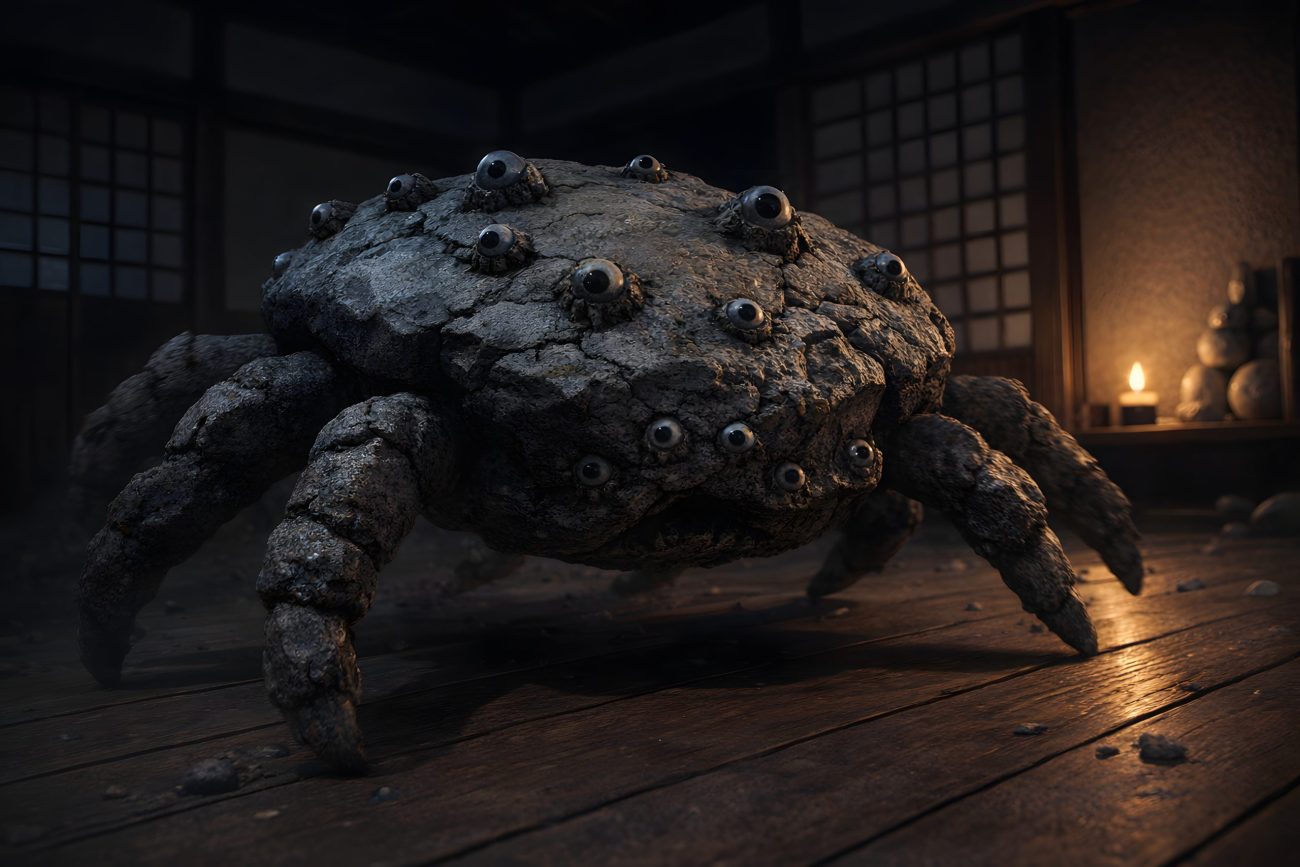
Me-te is a yōkai known from writings attributed to Sato Arifumi. It is described as a blind creature that wanders through open fields, moving as though it cannot see the world around it.

Despite its blindness, Me-te is extremely dangerous. People are warned never to mock or make light of it. Those who laugh at Me-te or assume it is helpless are said to be punished, for the yōkai will suddenly attack and suck out their eyeballs.

Me-te is also known by the name Te no Me, meaning “Eye of the Hand,” a name that reflects its strange and unsettling nature. In illustrations, it appears in a form similar to figures shown in Gazu Hyakki Yagyō, though it is depicted without wrinkles on the face, and its empty eye sockets are shown through deep shading.

Though little is recorded about its origin or fate, Me-te is remembered as a wandering field yōkai whose apparent weakness conceals a brutal and sudden threat.


Interpretive Lenses

Religious Readings
Philosophical Readings
Psychological Readings
Esoteric Deep Dive
Political / Social Readings
Other

Me-te (Te no Me) — A Hermeticism Deep Dive

Hermeticism treats sensory monsters not as grotesque curiosities, but as redistributions of perceptive authority, beings that expose how seeing, knowing, and judging can detach from their expected organs. Me-te is not blind in a simple sense; it is vision displaced, a creature formed where perception has migrated away from the face and reinstalled itself elsewhere.

What happens when sight no longer belongs to the eyes?


Lens Effect

Under this lens, Me-te appears as:
a displaced perceptual executor, enforcing humility through inverted sensory correspondence.

Primary effect on humans:
It punishes epistemic arrogance, stripping sight from those who mistake visibility for understanding.


1. Blindness and Wandering — Sensory Decentralization

Me-te’s apparent blindness signals ocular deprivation, but not perceptual absence. Hermetically, this is decentralized gnosis: awareness no longer anchored to the face, but diffused through the body.

Its wandering across open fields reflects non-directional perception. It does not navigate by horizon or goal, but by ambient sensitivity, responding only when provoked by judgment or mockery.


2. Eye of the Hand — Inverted Correspondence

The name Te no Me marks a correspondence inversion, where the organ of action becomes the organ of sight. Hermetically, the hand-eye substitution signifies operational vision—seeing that occurs only at the moment of grasping.

By removing the eyeballs of its attackers, Me-te performs perceptual rebalancing. Those who relied on vision without restraint lose it, while the creature that “cannot see” demonstrates true functional awareness.


Final Reading

Under a Hermetic lens, Me-te is sight redistributed according to humility, a yōkai that reveals how perception migrates when organs are misused. It exists to demonstrate that vision divorced from respect becomes a liability rather than an advantage.


Lesson for the Reader

Do not confuse visibility with mastery. What you see does not belong to you by default. When perception turns into mockery, it forfeits its right to remain. Some beings do not need eyes to know where you stand—and some punishments arrive not to blind, but to correct how you were seeing in the first place.


“When sight is used without reverence, it is reassigned.”

Beast of Cinglais

Tradition / Region: France (Normandy: Cinglais Forest, Caen, Évreux)
Alternate Names: Beast of Évreux, Beast of Caen
Category: Man-eating beast / wolf


The Myth

In the forests of Normandy, a man-eating beast was said to roam the woodland of Cinglais, south of Caen. The first attacks were recorded in the year 1632. For more than a month, the creature was blamed for repeated assaults on travelers and villagers, leaving dozens dead.

Contemporary reports describe the beast as moving between the forest of Cinglais and the road toward Falaise. Survivors of its attacks claimed it resembled a massive mastiff or wolf, far larger than ordinary animals. It was said to be impossibly fast, able to outrun any man on foot, and so agile that it leapt across rivers with ease. Some locals called the creature Therende. Attempts to shoot it with arquebuses failed, as the beast could not be wounded from a distance, and few dared to approach it alone.

Fear spread throughout the region. Priests rang the tocsin and called on parishioners to gather together for safety, warning that the beast attacked isolated individuals. Reports claimed that fifteen people had already been devoured by March of 1632, and the number continued to rise.

In June of 1633, authorities organized a massive hunt. Between five and six thousand men were assembled under orders to scour the forest. After several days of pursuit, the beast was finally brought down by a single arquebus shot. With its death, the attacks ceased.

The slain creature was identified as a kind of wolf, though unlike any commonly known. It was described as longer than ordinary wolves, redder in color, with a broader rump and a more sharply pointed tail. Although its body was examined, many believed that its unusual ferocity and endurance suggested sorcery or something unnatural.

The Beast of Cinglais was said to have claimed more than thirty lives in just over a year. Even after its death, its story remained fixed in memory as one of the most terrifying animal outbreaks ever recorded in Normandy.


Interpretive Lenses

Religious Readings
Philosophical Readings
Psychological Readings
Esoteric Deep Dive
Political / Social Readings
Other

Beast of Cinglais — A Hermeticism Deep Dive

Hermeticism reads historical man-eaters not as zoological anomalies, but as episodic condensations of predatory surplus, moments when collective fear, environmental pressure, and latent violence coagulate into a single operative form. Such beasts do not emerge outside order; they appear when order misfires locally, producing a temporary executor that enforces isolation, dispersion, and terror until forcibly reabsorbed. The Beast of Cinglais is not merely a wolf—it is predation stabilized by circumstance.

What kind of creature forms when fear itself becomes a hunting strategy?


Lens Effect

Under this lens, the Beast of Cinglais appears as:
a localized coagulum of predatory excess, sustained by social fragmentation and spatial vulnerability.

Primary effect on humans:
It weaponizes isolation, converting roads, forests, and solitude into lethal liabilities.


1. Repeated Attacks — Sustained Coagulation

The persistence of killings over more than a year marks stable manifestation, not random outbreak. Hermetically, this indicates coagulation reinforced by repetition: each successful kill thickens the event-field, making the next more likely.

The beast does not roam aimlessly; it patrols a circuit, fixing terror into geography between the forest of Cinglais Forest and the road toward Falaise. Space itself becomes operational.


2. Immunity to Firearms — Distributed Invulnerability

Reports that arquebus shots failed suggest not literal invincibility, but dispersed coherence. Hermetically, beings sustained by collective affect cannot be neutralized at range; they lack a single vulnerable center until correspondence collapses.

Fear diffuses the target. As long as the beast remains mythically reinforced, distance attacks fail because meaning still holds it together.


3. Speed and Size — Overclocked Vital Circuit

Descriptions of impossible speed and leaping mark accelerated circulation, vitality pushed beyond ordinary animal limits. Hermetically, this reflects borrowed force—energy drawn not from the organism alone but from environmental panic.

The beast runs faster because it is carried by terror, not muscle alone.


4. Priestly Alarm and Communal Clustering — Counter-Circulation

The ringing of the tocsin and warnings against isolation introduce protective re-aggregation. Hermetically, predators that feed on dispersion weaken when human circulation re-knits.

Community acts as decoagulating agent, breaking the feedback loop that sustains the beast’s efficacy.


5. Mass Hunt and Singular Death — Forced Re-Localization

The assembly of thousands to hunt the beast represents collective re-focusing, compressing diffuse fear into coordinated action. Hermetically, this restores locality, forcing the coagulum into a single body.

The final killing by one shot succeeds not because of superior weaponry, but because correspondence has collapsed. Once stripped of mythic surplus, the beast becomes killable flesh again.


Final Reading

Under a Hermetic lens, the Beast of Cinglais is predation temporarily stabilized by social fear, a creature sustained as much by panic and isolation as by teeth and muscle. Its death marks not only the end of an animal, but the dissolution of a terror-field that had exceeded natural bounds.


Lesson for the Reader

Beware conditions that isolate, scatter, and amplify fear. When communities fragment, violence concentrates. What preys upon you may not be singular at first—but if left unchallenged, it will condense into something that is. Restore circulation early, or be forced to destroy what fear has already made solid.


“What terror feeds on distance dies when distance is removed.”

Kepn

Tradition / Region: Karen folklore (Burma / Myanmar)
Alternate Names: Kephn
Category: Dog / vampire


The Myth

Among the Karen people of Burma, there is fear of a demonic vampire known as the Kepn. It is said to be created through the use of black or evil magic, and once formed, it can no longer live as an ordinary being. The Kepn exists only to hunt human souls and drink human blood.

The Kepn is described in two main forms. In one, it appears as a floating sorcerer’s head with its internal organs trailing beneath it, much like a male version of the Penangglan. This form drifts through the night air, seeking out victims while separated from the rest of its body.

In another form, the Kepn appears as a water-dwelling demon with the head of a dog. In this shape, it lurks near rivers, ponds, and wetlands, waiting for humans who come too close to the water. Whether flying through the air or hiding in water, the Kepn is always driven by hunger for blood and souls.

Both forms are regarded as equally dangerous, and both are understood to originate from sorcery rather than natural death. Because of this, the Kepn is feared not only as a monster, but as the result of forbidden practices that twist a human into something inhuman.

To the Karen people, the Kepn remains a hidden predator of the night and water, born of dark magic and sustained by human life.


Interpretive Lenses

Religious Readings
Philosophical Readings
Psychological Readings
Esoteric Deep Dive
Political / Social Readings
Other

Kepn — A Hermeticism Deep Dive

Hermeticism understands sorcerous vampires not as undead accidents, but as artificial inversions of the human circuit, beings produced when will intervenes violently in the separation of soul, body, and pneuma. The Kepn is not a revenant; it is a misconstructed remainder, created when forbidden praxis forces continuation after ontological rupture.

What kind of being results when separation occurs without release?


Lens Effect

Under this lens, the Kepn appears as:
a sorcerously fractured life-form, sustained by inverted circulation of blood and soul.

Primary effect on humans:
It drains vitality through parasitic misalignment, converting human coherence into fuel for its own persistence.


1. Creation by Black Magic — Illicit Coagulation

The Kepn originates through forbidden operative condensation, where magic is used not to dissolve or elevate, but to arrest transition. Hermetically, this is coagulation without purification, producing a being that persists without lawful correspondence.

Such entities cannot return to ordinary life because their internal circuits are closed incorrectly. Hunger replaces purpose; extraction replaces exchange.


2. Detached Head and Trailing Organs — Vertical Disjunction

The flying head form represents violent axial separation: intellect and appetite torn free from grounding body. Hermetically, this indicates pneumatic inversion, where the upper principle survives by feeding downward.

The exposed organs signify failed interiorization. What should remain hidden and regulated becomes external and predatory, seeking replacement substance to stabilize itself.


3. Dog-Headed Water Demon — Chthonic Regression

The aquatic canine form marks regressive embodiment, where human identity collapses into instinctual guardianship of thresholds. Water here is absorptive medium, allowing the Kepn to linger unseen while leeching vitality.

Hermetically, this form represents horizontal predation, contrasted with the vertical flight of the head—together completing a total parasitic field across air and water.


Final Reading

Under a Hermetic lens, the Kepn is human coherence forcibly interrupted, sustained only by consuming what it can no longer generate internally. It is not cursed by fate, but engineered by misuse, a warning that magic applied without ethical circulation produces entities that survive only by depletion.


Lesson for the Reader

Do not attempt to bind life beyond its lawful term. What is held together by force will demand payment in blood or spirit. Power that interrupts natural separation does not grant mastery—it creates hunger that never ends.


“What refuses to pass on must feed where it should have released.”

Triangular Beast (Triceratops)

Tradition / Region: China
Alternate Names: Triangular Deer
Category: Deer / auspicious beast


The Myth

The Triangular Beast is a mythical creature recorded in Chinese legend. It is described as a deer-like animal with three horns: one on the top of its head, one on its forehead, and one on its nose. Its body is red, and its feet are said to burn like flames, leaving fiery traces where it walks.

According to ancient descriptions, the Triangular Beast resembles a deer in form but differs in its unusual structure. It has a triangular body, a white belly, and a green tail. Its head is compared to that of a ze, with green hair, and it is often depicted on red banners or flags, especially in ceremonial contexts.

The creature is said to dwell on a western mountain, sometimes called the Western Convex Mountain. It does not appear at random. The Triangular Beast is regarded as an auspicious sign, and its appearance is believed to coincide with times of perfect order in the human world.

Several classical texts state that the Triangular Beast emerges only when the laws and regulations of former kings are faithfully upheld. When a ruler inherits the institutions of the past without alteration or neglect, the Triangular Beast is said to appear as a sign of harmony between heaven and the realm.

Thus, the Triangular Beast is remembered as a rare and sacred deer-like creature whose presence marks an age of rightful rule, established law, and cosmic balance.


Interpretive Lenses

Religious Readings
Philosophical Readings
Psychological Readings
Esoteric Deep Dive
Political / Social Readings
Other

Triangular Beast (Triceratops) — A Hermeticism Deep Dive

Hermeticism treats auspicious beasts not as rewards, but as diagnostic manifestations, signs that correspondence between heaven, law, and matter has reached temporary equilibrium. Such beings do not cause harmony; they become visible when harmony is already operative. The Triangular Beast is not summoned—it condenses out of correct order.

What kind of creature appears only when nothing needs correcting?


Lens Effect

Under this lens, the Triangular Beast appears as:
a herald of stabilized correspondence, where cosmic law and human governance coincide without friction.

Primary effect on humans:
It confirms legitimacy, making invisible order perceptible through form.


1. Three Horns — Triadic Coherence

The three horns signify triadic stabilization: heaven, earth, and human law locked into mutual alignment. Hermetically, triads mark completed mediation, where no excess leaks between planes.

Unlike weapons, these horns do not pierce outward. They anchor structure, fixing authority in balanced geometry rather than force.


2. Fiery Feet and Red Body — Regulated Vital Fire

Fire beneath the feet indicates active vitality, yet the creature does not burn the world. Hermetically, this is contained ignition, life-force circulating without rupture.

The red body signals visible yang, but disciplined—heat that moves lawfully, leaving traces without destruction. Power is present, but subordinate to order.


3. Appearance Only Under Ancient Law — Correspondence Confirmation

The beast emerges only when former institutions are preserved without distortion. Hermetically, this is temporal resonance, where past order remains correctly synchronized with present action.

The Triangular Beast does not judge rulers; it registers alignment. Its presence is evidence that law has become transparent to cosmos, requiring no enforcement.


Final Reading

Under a Hermetic lens, the Triangular Beast is order made visible, a rare condensation of harmony that appears when governance no longer resists cosmic structure. It is not a miracle, but a measurement.


Lesson for the Reader

Do not seek signs before correcting foundations. When order is genuine, confirmation arrives uninvited. What must be forced is not aligned; what is aligned eventually takes shape on its own.


“When law moves without friction, the world grows horns instead of weapons.”

Jatai

Tradition / Region: Japan (Ehime Prefecture and other regions)
Alternate Names:
Category: Object/ yōkai


The Myth

The Jatai is said to appear at night as a living obi, a kimono sash that moves on its own like a great snake. By day it is nothing more than a length of cloth, but after night falls it slithers from its resting place, coiling and gliding through rooms in search of victims.

According to old folk belief, if a person lays an obi near their pillow while sleeping, they may dream of snakes. From this belief grew the story that the obi itself can transform. Because the word for a snake’s body sounds the same as the word for a wicked heart, the sash was believed to awaken as a murderous being. In this form it becomes the Jatai, a dangerous tsukumogami born from jealousy and malice.

The Jatai is especially associated with an obi once worn by a jealous woman. After long use, the resentment bound into the garment gives it life. When it hunts, it wraps itself around sleeping men and strangles them in their beds.

The creature is described as a poisonous snake, long enough to coil itself around a person seven times. This detail is remembered as part of its fearsome nature and its unnatural length. Once the Jatai has tightened its coils, escape is said to be impossible.

The Jatai is depicted in Toriyama Sekien’s Konjaku Hyakki Shūi, where it appears as a living sash transformed into a deadly serpent. Through these tales, the Jatai is remembered as a reminder that strong emotions can linger in objects, waiting for the moment when they take on a life of their own.


Interpretive Lenses

Religious Readings
Philosophical Readings
Psychological Readings
Esoteric Deep Dive
Political / Social Readings
Other

Jatai — A Hermeticism Deep Dive

Hermeticism treats tsukumogami not as curiosities of animation, but as cases of affective coagulation, where repeated emotional charge fixes itself into matter until matter becomes operative. Objects do not awaken randomly; they awaken when residue outweighs neutrality. The Jatai is not cloth that turns into a snake—it is malice that finds a body already shaped for constriction.

What kind of hatred does not dissipate, but learns how to bind?


Lens Effect

Under this lens, the Jatai appears as:
a constrictive affect-form, emotion coagulated into strangling function.

Primary effect on humans:
It weaponizes intimacy, turning proximity and trust into conditions for suffocation.


1. Night Animation — Nocturnal Activation of Residue

By day the obi remains inert; by night it moves. Hermetically, night is the domain of affective release, when diurnal containment weakens and stored impressions become mobile.

The Jatai activates when conscious governance recedes, indicating that its force does not oppose vigilance—it waits for its absence.


2. Obi as Form — Prefigured Constriction

The obi is already a binding object, designed to wrap, tighten, and hold the body in place. Hermetically, this makes it a pre-adapted vessel for constrictive intent.

Transformation here is not radical; it is functional intensification. The object becomes what it always was, but without restraint.


3. Homophony of Snake and Heart — Linguistic Correspondence Leak

The phonetic overlap between “snake body” and “wicked heart” reveals semantic permeability. Hermetically, language is not neutral—it is a circulatory channel through which meaning migrates into matter.

The Jatai emerges where sound-based correspondence allows inner vice to externalize. Speech shapes substance.


4. Jealous Garment — Affective Saturation

Long use by a jealous woman saturates the obi with repetitive emotional imprinting. Hermetically, this is affective fixation, where emotion ceases to pass through and instead settles.

Once saturation reaches threshold, the object no longer reflects emotion—it executes it.


5. Seven Coils — Ritual Totalization

The detail of seven coils signals total encirclement. Hermetically, seven marks complete operational cycle, the point at which no remainder of agency remains outside the system.

Strangulation here is not physical alone; it is existential closure. The victim is not attacked—they are fully included.


6. Bed and Sleep — Violation of Protective Zones

The Jatai kills sleepers, those who have lowered defenses within spaces of presumed safety. Hermetically, this is intimate inversion, where protective zones become lethal because affect has learned their rhythms.

What is closest becomes most dangerous once correspondence turns hostile.


Final Reading

Under a Hermetic lens, the Jatai is emotion that has lost its owner, jealousy condensed into a self-moving instrument of constriction. It demonstrates that objects absorb not memory but function, and when affect coagulates long enough, it will seek completion through action.


Lesson for the Reader

Do not assume emotions vanish when unspoken. What is repeatedly felt and never released does not fade—it settles. Bindings meant to adorn can become bindings meant to kill. Tend to what you wrap around your life, because what holds you can learn how to close.


“What is worn in silence learns to tighten on its own.”